Key outcomes
- Prior workload: 40 hours spent on billing each cycle before Dagny, reported by Mogl
- First live day: More than 80% of the billing work finished, reported by Mogl
- Finance team's experience: Tenfold less billing stress, reported by Mogl's finance team
About Mogl
Mogl empowers growth for mid-market advertisers. As the largest reseller of enterprise technology for the mid-market, Mogl gives brands and agencies access and expertise across the world's best platforms and products, backed by world-class service that drives measurable performance. Mogl's four divisions, Growth, Commerce, Data and Labs, cover programmatic media, retail and commerce media, data and reporting, and measurement and AI. Learn more at mogl.com.
The billing challenge
Every month, Mogl's finance team turns media spend on The Trade Desk and Walmart DSP into customer invoices. The core systems were already in place. Spend lived in Snowflake, customer details flowed in from Salesforce, and QuickBooks Online held the books.
The hard part was everything in between. Billing ran through a monthly Excel workbook that finance maintained by hand. The workbook tracked current and prior-month spend, discount tiers, customer mappings, reconciliation checks, special reporting, and prepaid adjustments. Business operations spent about 40 hours on billing each cycle.
Blueprint: finding where the hours went
Dagny starts every engagement by sitting with the people who do the work. A Dagny Agentic Athlete, an operator with a career in finance and billing, walked through the monthly process with Mogl's finance and data teams to map where the time went.
Creating an invoice was the easy part. Before anything went to QuickBooks, finance had to match spend to the right customer and advertiser, apply the right contract terms, and catch the exceptions.
Every customer was a little different. Some discounts were based on last month's spend, others on the current month. Prepaid customers needed a credit, not another bill. Some customers needed extra reporting or custom invoices.
Those rules were scattered across workbook tabs, source reports, customer records, and one-off edits. Finance rebuilt the same picture every month. The first build was clear: a billing system on top of the data Mogl already had.
Build: Billing OS
The Agentic Athlete shaped the first version of Billing OS from Mogl's source data. A Dagny forward-deployed engineer then hardened the system with Mogl's finance and data teams, adding validation while leaving room for real customer exceptions. QuickBooks stayed the system of record, and finance kept control of every customer-specific decision.
Salesforce, then Snowflake, then Billing OS, then QuickBooks Online
Snowflake and Salesforce feed Billing OS, where finance reviews and approves invoices before they move to QuickBooks.
Spend and customer terms in one view
Customer records, platform spend, advertiser detail, discounts, and payment terms sat side by side. Finance could see the numbers behind each invoice and download spend as a CSV, with no workbook to rebuild.
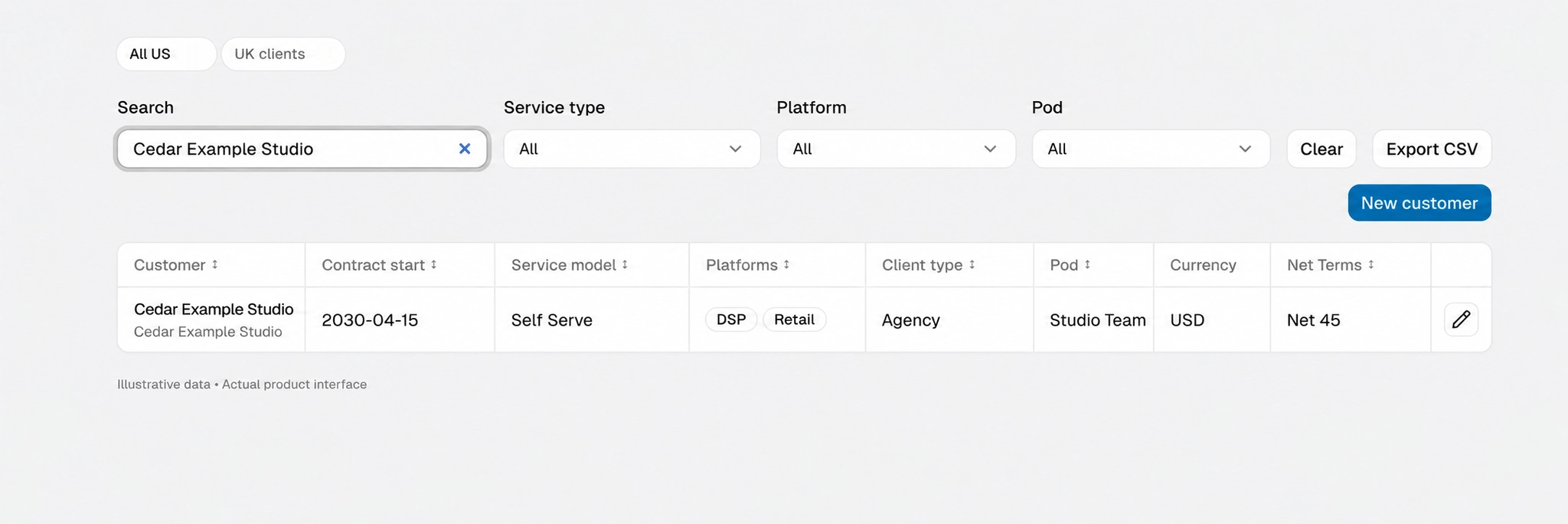
The Billing OS customer view, with contract start, platforms, client type, and payment terms for each account. Illustrative data.
A review step before anything reaches a customer
Draft invoices landed in a review queue. Approving an invoice created the QuickBooks record, and sending was a separate step. Nobody could approve their own work, and an activity log showed who changed what.
Adjustments without starting over
Finance could add products and services, apply fees, and enter credits for prepaid customers. Customer tags and notes flagged accounts with special reporting needs.
Reconciliation that explains the differences
The reconciliation view showed spend with no matching customer, customers missing contract terms, and any gap between Billing OS and QuickBooks. Finance could open a difference and see whether the gap was a real error or an expected exception, like a non-media invoice.
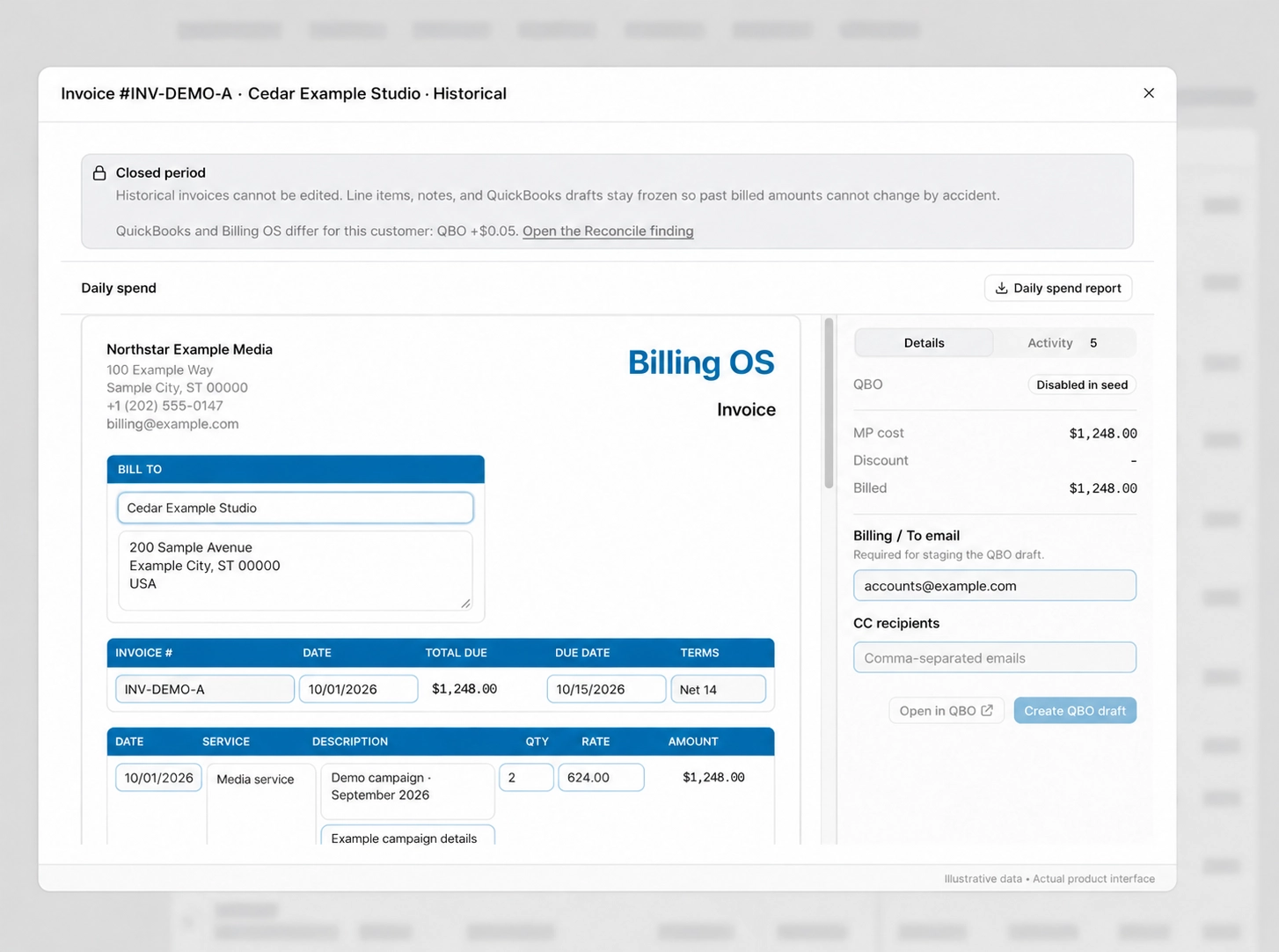
An invoice in Billing OS, with daily spend, billing totals, and a flagged difference from QuickBooks. Illustrative data.
The monthly process became:
- Pull spend and customer details into Billing OS.
- Review each draft invoice against the customer's terms.
- Resolve exceptions and add any adjustments.
- Approve the invoice into QuickBooks.
- Send the invoice once finance signs off.
Run: the first live billing day
The first live session was planned as a walkthrough. Instead, the team started billing for real. The next morning, the finance team reported that they had finished more than 80% of the billing work on day one.
Finance moved quickly through routine invoices and spent their time on the exceptions. The team said billing stress dropped tenfold.
Billing OS runs in Mogl's own infrastructure, so Mogl owns the code, the accounts and the data.
“Dagny made my month. I've solved the invoicing problem.”
Davis Miller, Controller, Mogl
Compound: the roadmap ahead
The first live run turned into a roadmap. Dagny keeps refining Billing OS with Mogl's finance team, using what each billing cycle teaches to decide what to build next.
The next phases target the finance work that still takes manual effort: tracking prepaid balances, tracking payments, and bringing UK invoicing into the same workflow. Each phase reuses the customer data and billing rules already in Billing OS, so new work starts from a running system instead of a blank page.
As Mogl adds customers, platforms, and markets, billing can grow without a matching rise in manual work, and finance can spend more time on the customer relationships that set Mogl apart.
Connected tools
| System | Role in the workflow |
|---|---|
| Snowflake | Source for platform spend and customer details. |
| Salesforce | Customer and contract information that feeds Snowflake. |
| Billing OS by Dagny | Where invoices are prepared, reviewed, adjusted, approved, and reconciled. Built by Dagny, hosted in Mogl's infrastructure. |
| QuickBooks Online | The books, and where invoices go out to customers. |
Takeaway
Mogl's data team had already centralized spend and customer records in Snowflake, fed by Salesforce. What finance lacked was a faster way to turn those records into invoices. Dagny built that workflow with Mogl's finance team, and finance finished most of the month's billing on the first day. Dagny keeps improving Billing OS as Mogl's billing needs grow.
 QBR Media
 Riemer Insurance Group